Burgundy Vineyards: the Côte de Nuits, Côte de Beaune and Chablis
Hours, prices and access verified by the Burgundy Tours team — last checked 2026-09-18.
Burgundy names its wine after the place the grapes grew, down to a single
walled plot. Once you can read the four levels on a label, you know what each tasting pours
and why the fares differ. It is the thing to learn before you compare
burgundy vineyard tours.
The region covers 28,841 hectares of vines, about 3% of France's wine growing, over 230 km
north to south. Most tours spend their day on one slope of it, the Côte d'Or south of Dijon,
which splits into the Côte de Nuits and the Côte de Beaune.
The classification: Régionale, Village, Premier Cru and Grand Cru
The BIVB counts 84 appellations in Burgundy. Other names you see on labels are
geographical additions, not appellations of their own. The table shows the four levels,
from the broadest to the most precise.
Level
How many
What the label names
An example
Régionale
7 appellations
The region, sometimes with a grape or an area
Bourgogne, Crémant de Bourgogne
Village
44 appellations
The village the grapes grew in
Meursault, Gevrey-Chambertin
Premier Cru
Climats within the Village appellations
The village plus the name of the climat
A named climat of Meursault
Grand Cru
33 appellations
The climat's name alone
Corton, Clos de Vougeot
The higher the level, the smaller the place on the label. A Grand Cru needs no village
name at all. On a tour, the level is what the fare buys you: the Grand Cru route day from
Beaune pours 14 wines, from Village and Premier Cru to one Grand Cru.
The 1,247 Climats and the UNESCO listing (2015)
A climat is a vineyard parcel with its own soil, slope and exposure, precisely marked on
the ground. UNESCO listed 1,247 of them in 2015, on the slopes of the Côte de Nuits and the
Côte de Beaune. They run 50 km south of Dijon, as far as Maranges.
You can still see many of the boundaries: paths, stone walls, fences and the stone
heaps called meurgers. The monks, first the Benedictines and then the Cistercians, and the
Valois Dukes of Burgundy drew the system from the High Middle Ages. The appellation decrees
of 1936 still regulate it.
The listing also takes in the town of Beaune and the centre of Dijon. Chablis, the
Mâconnais and the Beaujolais lie outside it. So when a day promises you UNESCO vineyards, it
means the Côte d'Or.
The Côte de Nuits: Gevrey-Chambertin to Nuits-Saint-Georges
The Côte de Nuits is the northern half of the Côte d'Or, starting just south of Dijon.
Its villages sit close together, so a day here covers several of them.
Gevrey-Chambertin
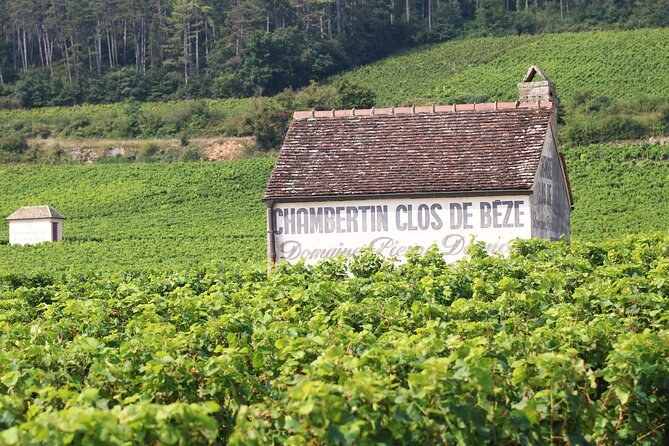
The first village on the road from Dijon, and the home of Chambertin Clos de Bèze. The
e-bike day pours its first and last cellars here, and the Ophorus day from Dijon starts its
tastings here.
A stone hut painted Chambertin Clos de Bèze among the vine rows below a wooded slope
Chambolle-Musigny
The Grand Cru route day spends an hour in the village, after its first domain tasting.
It is one of the villages that keep that day on the Côte de Nuits.
Vosne-Romanée
The village of the Romanée-Conti vineyard. Two private days taste at a winery here, and
the private route day from Beaune adds the Hautes Côtes de Nuits above it.
Nuits-Saint-Georges
The town that gives the Côte its name. The e-bike day stops here for an hour before it
rides back to Gevrey-Chambertin.
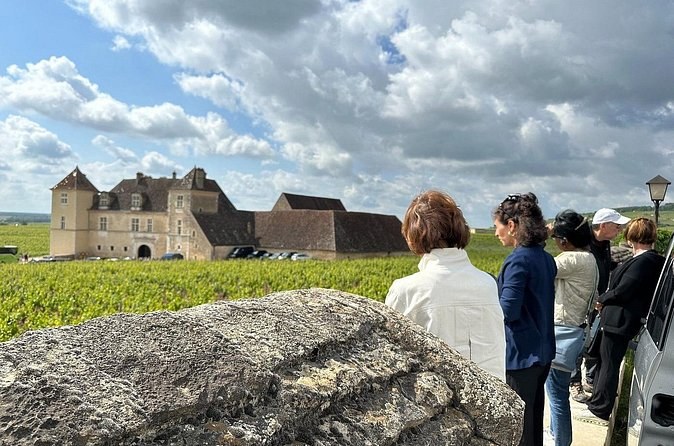
The Clos de Vougeot: 51 walled hectares and a Cistercian château
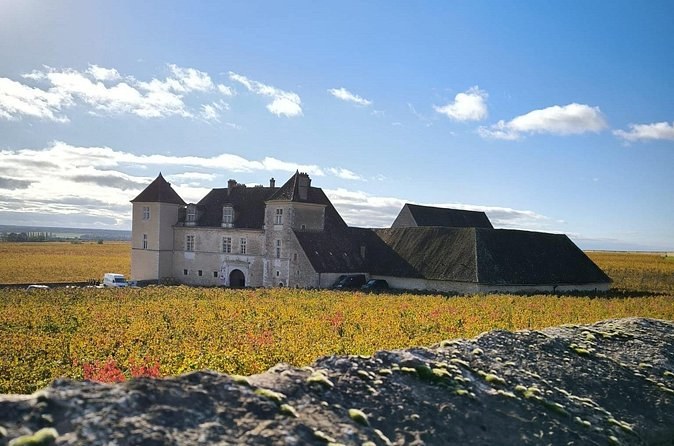
Monks from the nearby Abbey of Cîteaux built the Clos de Vougeot in the 12th century as a
wine farm. A Renaissance château followed in the 16th century. Inside you see the medieval
vat-house and presses, the Cistercian cellar and the old kitchens.
The château no longer makes wine. The Confrérie des Chevaliers du Tastevin bought it in
1945 and restored it as the seat of its order. Its wall still closes almost 51 hectares of
vines in one piece.
The Clos de Vougeot's château behind its walled vineyard, the vines turning gold
You can see it in four ways. Each block below keeps the same labels, so you can compare
them.
On your own
Inclusions: the château at your own pace, every day of the year.
Best for: a visit by car or bike, on a day with no tour.
Book: at the ticket office; the admission price is shown on the day.
The guided tour in English
Inclusions: a guide at 11:30 am or 3:30 pm, EUR 15, or EUR 7 for ages 8 to
16 and students. Best for: the history of the order and the presses.
Book: by reservation, and ask about heat: the château shortens tours in
extreme heat.
A tour with the entry in the fare
Inclusions: the entry, then tastings at wineries in Vosne-Romanée and
beyond. Best for: the château and the cellars in one day, with a driver.
Book: the private route day from Beaune ($1,170 for up to four) or
the À La Française private day.
A stop outside the wall
Inclusions: ten minutes outside the château, with no entry.
Best for: a first look while the day spends its hours in the domains.
Book: the Grand Cru route day, or the e-bike day, which rides past.
Season
Château open
Ticket office closes
English guided tour
1 April to 31 October
9:30 am–6 pm, every day
5:30 pm
11:30 am and 3:30 pm
1 November to 31 March
10 am–5 pm, every day
4:30 pm
11:30 am and 3:30 pm
Want the château and the cellars in one day?
Two private days put the Clos de Vougeot's entry in the fare, then drive you on to taste in Vosne-Romanée.
Romanée-Conti is a Grand Cru vineyard in Vosne-Romanée. You see it the way most visitors
do: from the edge of the vines. The e-bike day from Dijon rides there, and the Bourgogne
Gold private day names it on its route with Clos de Bèze.
None of these days includes a visit inside the domaine, so do not expect a tasting of its
wine. Take the photograph from the road, and taste the village's other wines at the winery
your day books.
The Côte de Beaune: Aloxe-Corton to Puligny-Montrachet
South of Nuits-Saint-Georges, the Côte de Beaune runs past Beaune to Santenay and
Maranges. This is where the white-wine days go.
Aloxe-Corton and the Corton hill
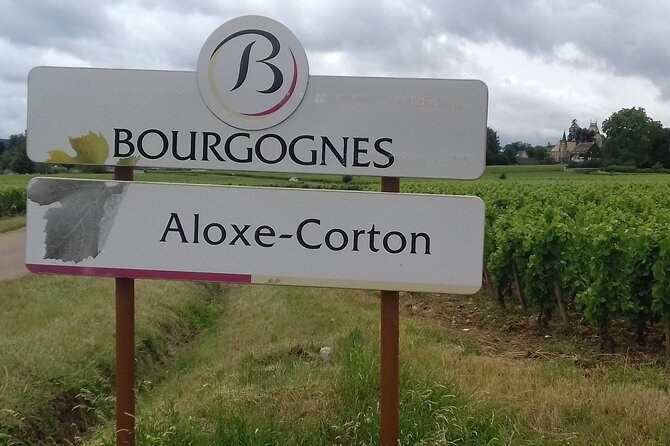
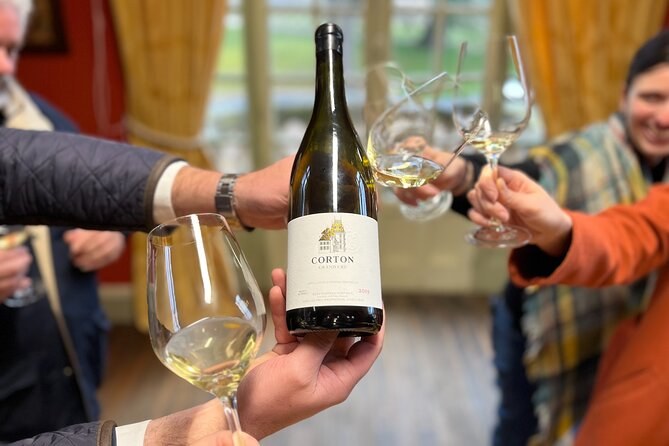
The hill of Corton stands at the northern end of the Côte de Beaune. The Authentica day
from Dijon stops for the view over it, and the private route day from Beaune tastes in the
village.
A Bourgognes sign for the village of Aloxe-Corton beside the vines
Pommard and Volnay
Two villages just south of Beaune. The 2CV half day drives you through both in a
Citroën 2CV, and the private day from Paris tastes at the Château de Pommard.
Meursault
Meursault is the heart of the white-wine days. The small-group day from Dijon
spends two hours in its cellars, and the 2CV half day pours its five wines here.
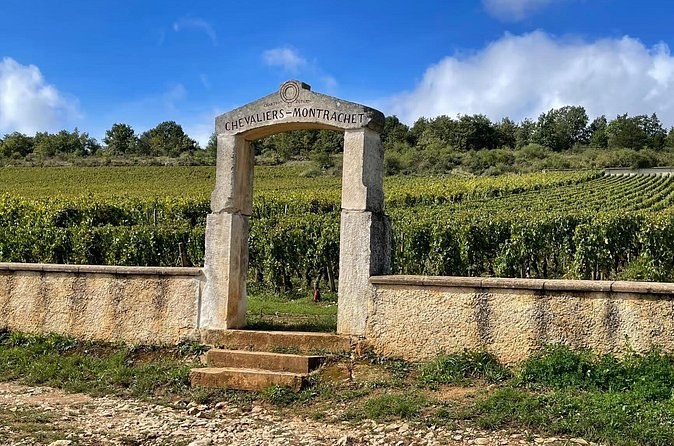
Puligny-Montrachet and Chassagne-Montrachet
The southern end of the white-wine villages. The small-group day from Dijon spends two
hours at a Puligny-Montrachet winery, and the 10-cru Authentica private day drives on to
Chassagne-Montrachet.
A stone gateway inscribed Chevaliers-Montrachet in the wall of a vineyard
Chablis, and the Crémant cellars
Chablis is the northern outpost of the region, about two hours from Paris by road and far
from the Côte. Its wines are white, from Chardonnay. The days from Paris spend their hours
here, with tastings at Domaine Jean-Marc Brocard and Domaine Bersan.
The shared day from Paris ends at the Caves Bailly Lapierre with a 30-minute Crémant
tasting. Crémant de Bourgogne is the region's sparkling wine, about 8% of what it makes.
The two Paris days are on Burgundy tours from Paris.
Grapes by the numbers: Chardonnay 57%, Pinot Noir 34%
Burgundy grows mostly two grapes. The BIVB's figures, by vineyard area and by what the
region makes, are below.
Grape
Share of the vineyard area
Chardonnay
57%
Pinot Noir
34%
Aligoté
6%
Gamay, Sauvignon, César and others
3%
Wine
Share of production
White
62%
Red
29%
Crémant de Bourgogne
8%
Rosé
1%
Both grapes grow along the whole Côte. The tours split the other way: the Côte de Nuits days
are built around the red Grand Cru villages, and the Côte de Beaune days around the great
whites. If you prefer white wine, a Côte de Beaune day or Chablis suits you best.
Questions about the vineyards
Can I visit Romanée-Conti?
You can see the vineyard, in Vosne-Romanée, from the road that passes it. The e-bike day from Dijon rides to it, and the Bourgogne Gold private day names it on its route. None of them includes a visit inside the domaine.
What is a climat in Burgundy?
A climat is a precisely marked vineyard parcel with its own soil, slope and exposure. UNESCO counts 1,247 of them on the Côte de Nuits and the Côte de Beaune, listed in 2015.
How many Grands Crus are there in Burgundy?
The BIVB counts 33 Grand Cru appellations among the region's 84. The Premier Crus are not separate appellations: they are climats within the Village ones.
How much is a guided tour of the Clos de Vougeot?
EUR 15 for an adult and EUR 7 for ages 8 to 16 and students, by reservation. The tour in English runs at 11:30 am and 3:30 pm every day.
Which grape is grown most in Burgundy?
Chardonnay, on 57% of the vineyard area, then Pinot Noir on 34%. White wine is 62% of what the region makes.
Where these facts come from
The figures come from the BIVB, the Climats from UNESCO, and the château from the Clos de
Vougeot's own pages. The stops come from each tour's booking page. Verify before you
travel.
Fourteen wines from the Beaune tourist office at 9:30 am, Village and Premier Cru up to one Grand Cru, with the Route des Grands Crus between tastings. Lunch is extra.
Your own guide-driver from a Beaune-area hotel: the Clos de Vougeot with entry, wineries in Vosne-Romanée and Aloxe-Corton, and the Hautes Côtes de Nuits.
A private day from your hotel in Dijon or Beaune at 9 am: the Clos de Vougeot with entry, eight wines at two family estates, and lunch in Beaune at your cost.